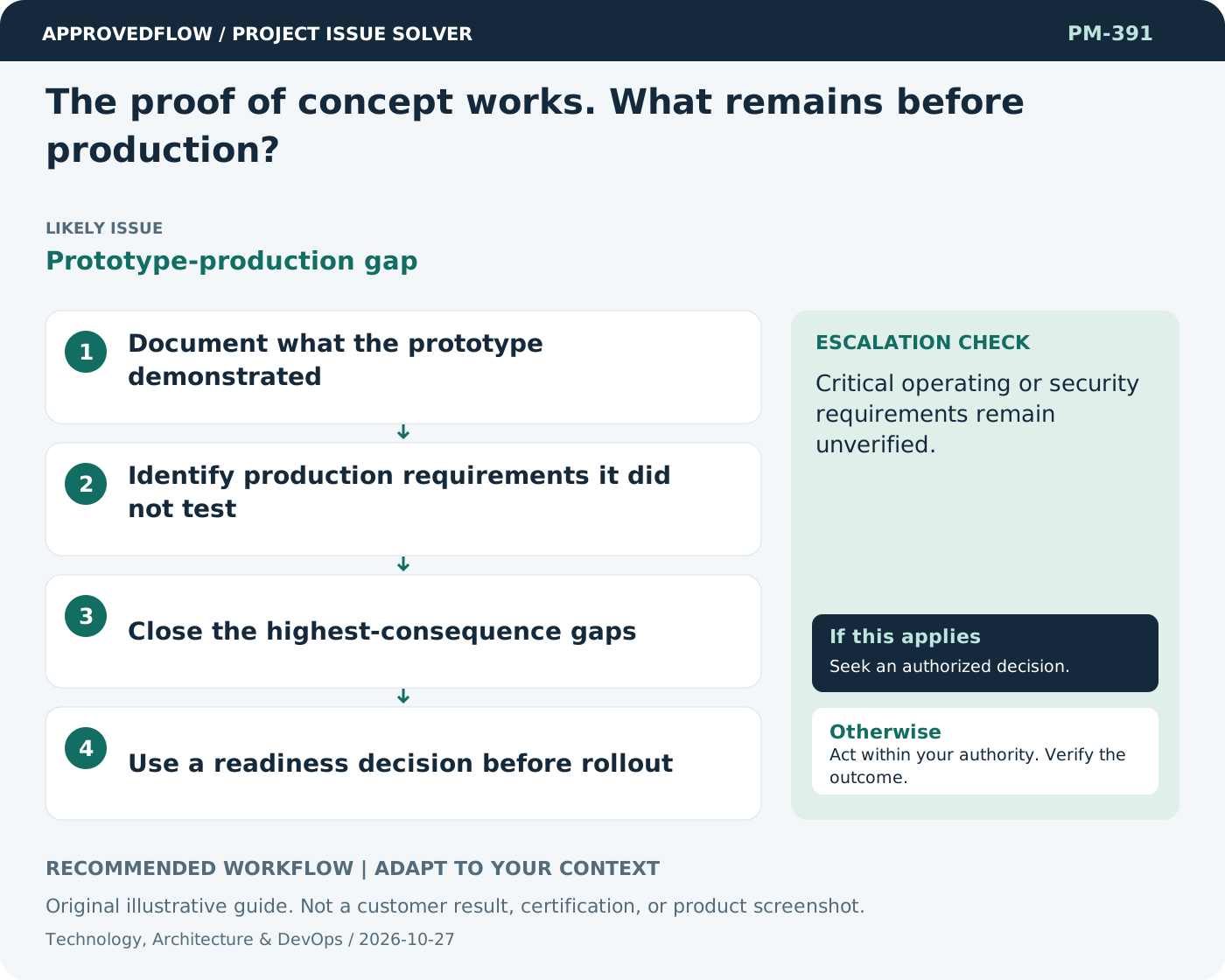
The proof of concept works. What remains before production?
Prototype-production gapAssess reliability, security, permissions, data handling, support, monitoring, deployment, and user acceptance. A proof of concept establishes only the capabilities actually tested under its conditions.
What to do now
- Document what the prototype demonstrated
- Identify production requirements it did not test
- Close the highest-consequence gaps
- Use a readiness decision before rollout
When to escalate
Critical operating or security requirements remain unverified.
The technical owner and authorized release decision maker
Example
A prototype gains access controls, recovery testing, and operational ownership before real users depend on it.
Mistake to avoid
Relabeling the demo environment as production without further work.
Prevent a repeat
Review real execution evidence and maintainability alongside feature completion; do not treat an unrun test as passed.
Suggested ApprovedFlow setup
- Tasks
- Documents
- Approvals
Track delivery tasks and attach engineering evidence; keep source control, build execution and technical controls in their actual engineering systems. See the platform
Related cases
- Our test suite passes, but production failures continue. What should we inspect?Test relevance gap
- How do we know a technical project is ready for handover?Incomplete technical transition
- A contractor finishes their tasks but remains booked for months. What should we review?Stale capacity reservation
- We have no owner after the AI pilot succeeds. What should happen before launch?Missing AI service ownership