How do we estimate work we have never done before?
High-uncertainty estimationUse discovery, analogies, and ranges rather than a precise-looking guess. Reduce the most important uncertainty before committing to detailed dates.
What to do now
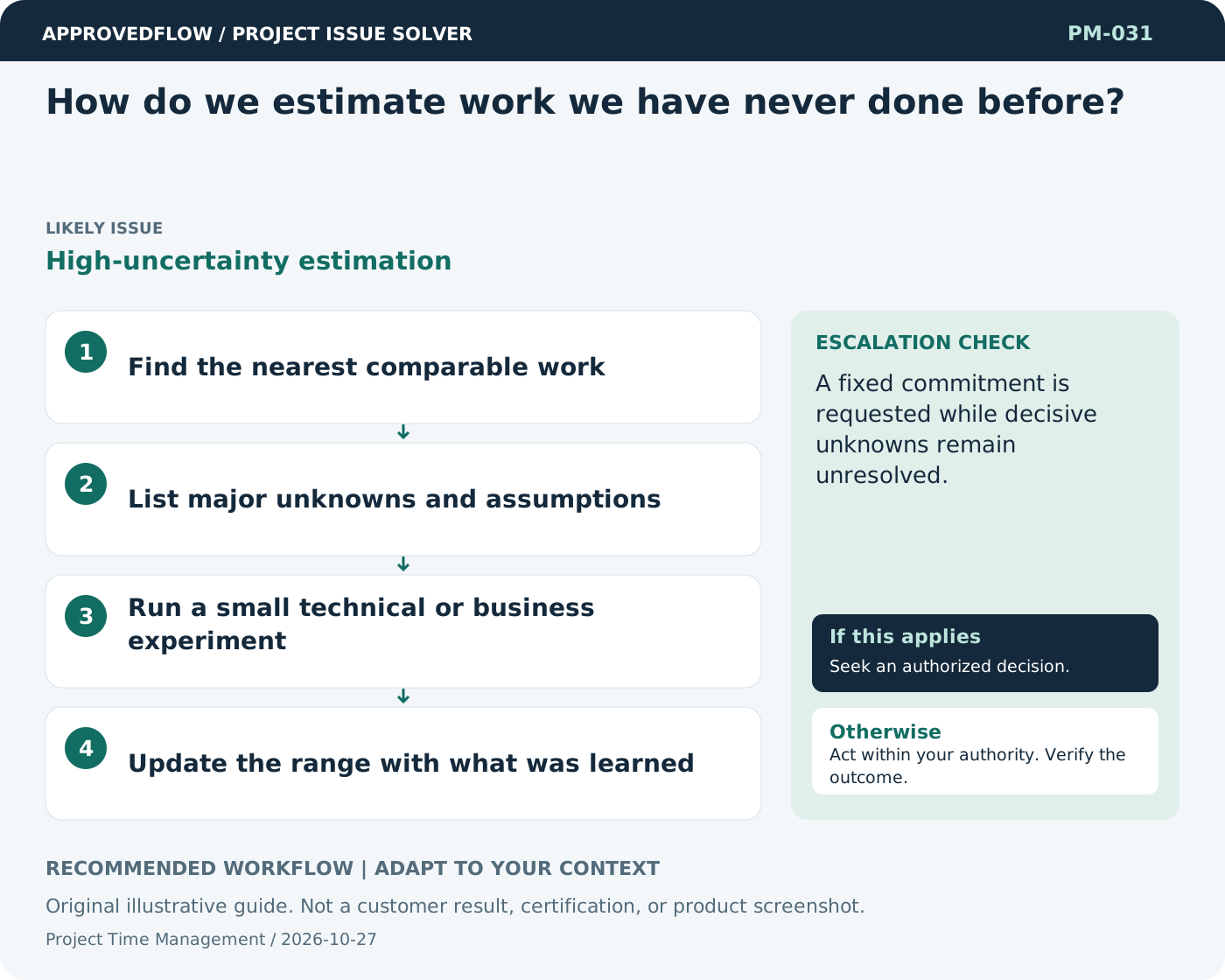
- Find the nearest comparable work
- List major unknowns and assumptions
- Run a small technical or business experiment
- Update the range with what was learned
When to escalate
Escalate when
A fixed commitment is requested while decisive unknowns remain unresolved.
Who decides
The project manager and relevant commitment owner
Example
A team tests one difficult data conversion before estimating migration of the remaining datasets.
Mistake to avoid
Presenting an unfamiliar task estimate as a guaranteed finish date.
Prevent a repeat
Compare forecast versus actual results for comparable tasks, separating effort, elapsed time, waiting and scope change.
Suggested ApprovedFlow setup
- Tasks
- Timesheets
- Resources
Keep planned dates and assumptions with the affected task, compare recorded actuals, and attach the revised forecast for review. See the platform
Related cases
- The estimate includes coding but not testing or rework. How should we revise it?Incomplete work estimate
- The deadline never changes, but the remaining work keeps growing. What should we show?Forecast-baseline disconnect
- The team estimates stories before understanding them. What should happen?Premature backlog estimation
- The team counts partially finished stories as done. How should we report them?Incomplete work misclassified