Monitoring shows servers are healthy, but users cannot complete transactions. Why?
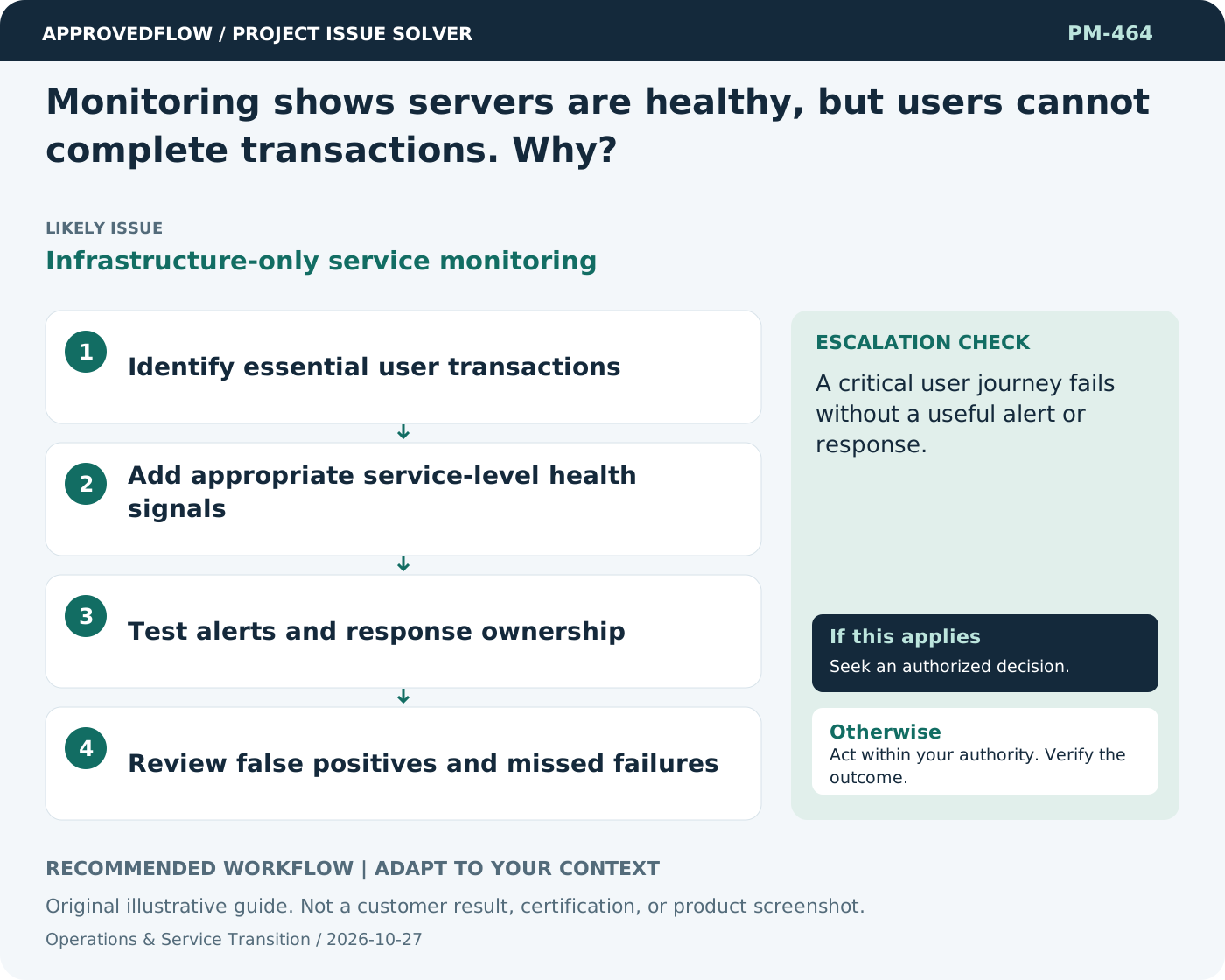
Infrastructure-only service monitoringMonitor the user-visible service and important transaction paths as well as infrastructure health. Define signals that reflect successful business use, with safe handling of monitoring data. Test alerts against realistic failures so the support team knows which signal requires action.
What to do now
- Identify essential user transactions
- Add appropriate service-level health signals
- Test alerts and response ownership
- Review false positives and missed failures
When to escalate
A critical user journey fails without a useful alert or response.
The service owner and authorized operational decision maker
Example
An approval submission check detects a failed workflow even though the application server remains online.
Mistake to avoid
Assuming a running server means the business service is working.
Prevent a repeat
Test whether receiving teams can operate and recover the service without depending on informal project-team support.
Suggested ApprovedFlow setup
- Tasks
- Documents
- Approvals
Keep handover tasks, operating evidence and the acceptance decision linked to the project while retaining monitoring and incident control in the actual service tools. See the platform
Related cases
- The fallback procedure creates duplicate transactions. How do we avoid that?Uncontrolled outage reconciliation
- New employees cannot get access without contacting the old project team. What is missing?Incomplete access-service transition
- Developers say the feature works, but users cannot complete the process. What is missing?Component success without user journey
- Users with accessibility needs cannot complete the new workflow. What do we do?Exclusionary implementation