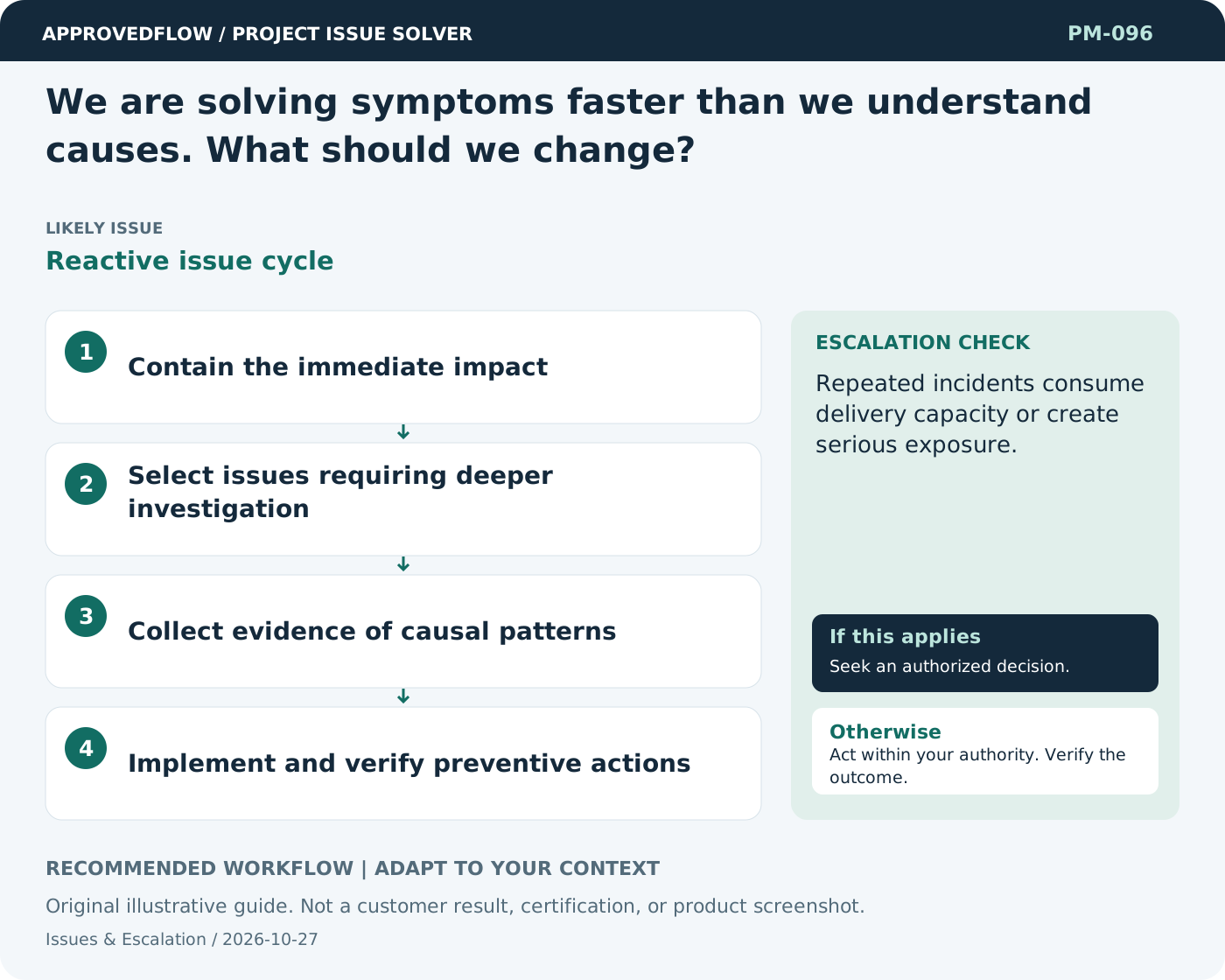
We are solving symptoms faster than we understand causes. What should we change?
Reactive issue cycleSeparate immediate restoration from a time-boxed investigation of repeated or significant failures. Protect service now while assigning accountable work to prevent recurrence.
What to do now
- Contain the immediate impact
- Select issues requiring deeper investigation
- Collect evidence of causal patterns
- Implement and verify preventive actions
When to escalate
Escalate when
Repeated incidents consume delivery capacity or create serious exposure.
Who decides
The issue owner or delegated decision authority
Example
A team restores a failed job, then investigates why the same input pattern repeatedly triggers failure.
Mistake to avoid
Launching a lengthy investigation before urgent containment.
Prevent a repeat
Track unresolved decision age and verify the outcome before treating an issue as closed.
Suggested ApprovedFlow setup
- Tasks
- Documents
- Approvals
Record the issue and next action on an owned task, attach evidence, and route the unresolved decision to the proper authority. See the platform
Related cases
- How do we distinguish an issue from a change request?Resolution-versus-baseline decision
- We have a workaround but no permanent fix. Can we move on?Uncontrolled temporary workaround
- The project is spending faster than planned. What should I check first?Unexplained cost variance
- Demand is growing faster than the capacity plan. What should we review?Unmanaged service scaling risk