We discover integration problems only before release. How can we improve?
Late integration feedbackIntegrate smaller changes and verify important interfaces throughout delivery. Shorter feedback loops help expose incompatible assumptions before they accumulate into a large final problem.
What to do now
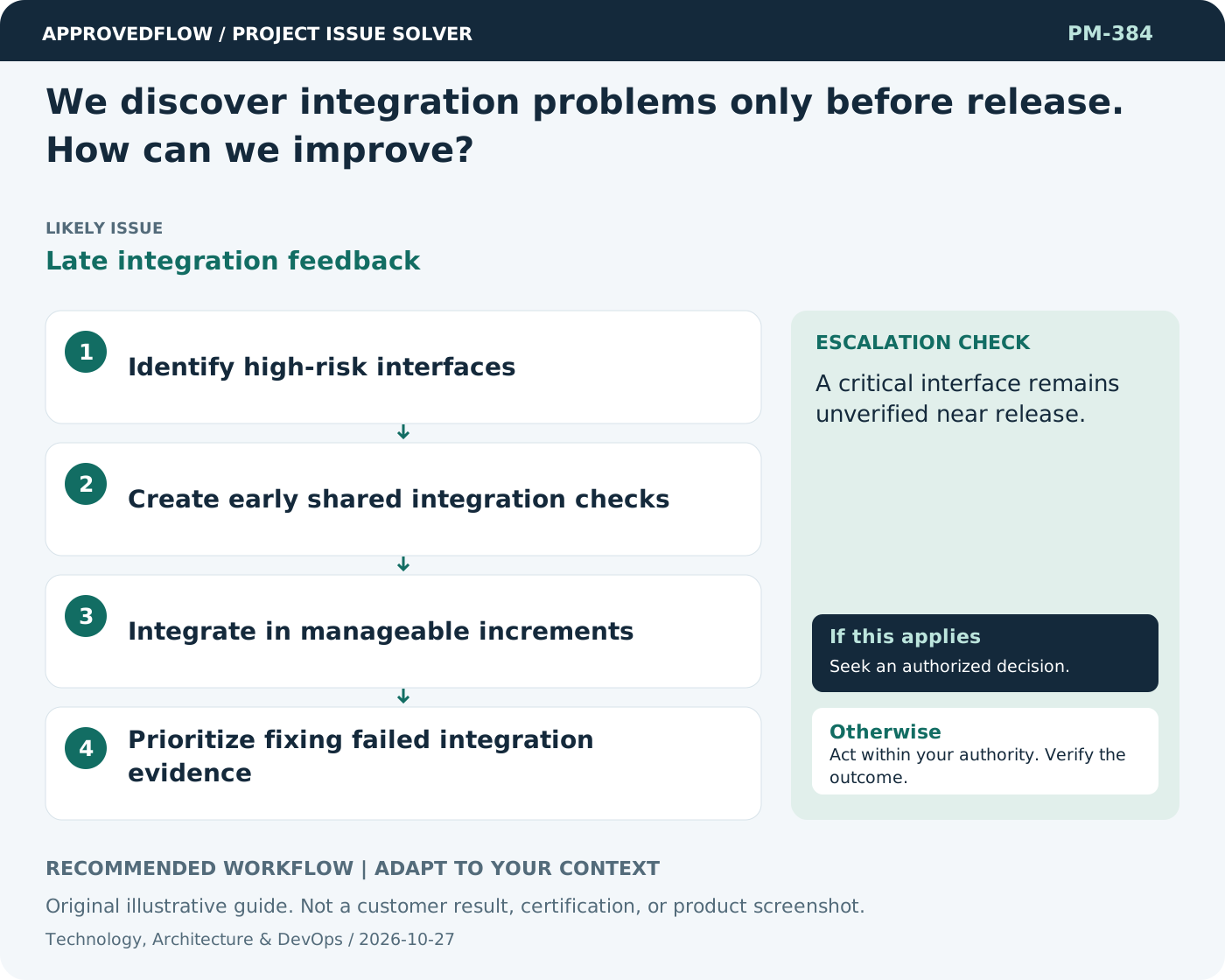
- Identify high-risk interfaces
- Create early shared integration checks
- Integrate in manageable increments
- Prioritize fixing failed integration evidence
When to escalate
Escalate when
A critical interface remains unverified near release.
Who decides
The technical owner and authorized release decision maker
Example
Teams run a shared transaction scenario as each interface change becomes available.
Mistake to avoid
Maintaining separate branches or components until the final week.
Prevent a repeat
Review real execution evidence and maintainability alongside feature completion; do not treat an unrun test as passed.
Suggested ApprovedFlow setup
- Tasks
- Documents
- Approvals
Track delivery tasks and attach engineering evidence; keep source control, build execution and technical controls in their actual engineering systems. See the platform
Related cases
- Developers keep adding new libraries. What should we control?Unmanaged software dependencies
- The team proposes a complete rewrite. What evidence should we request?Unvalidated replacement strategy
- Testing is scheduled only at the end. How can we reduce risk now?Late quality feedback
- We call ourselves agile but release only once a year. Is that necessarily wrong?Iteration without usable feedback