Should every task have a fixed date?
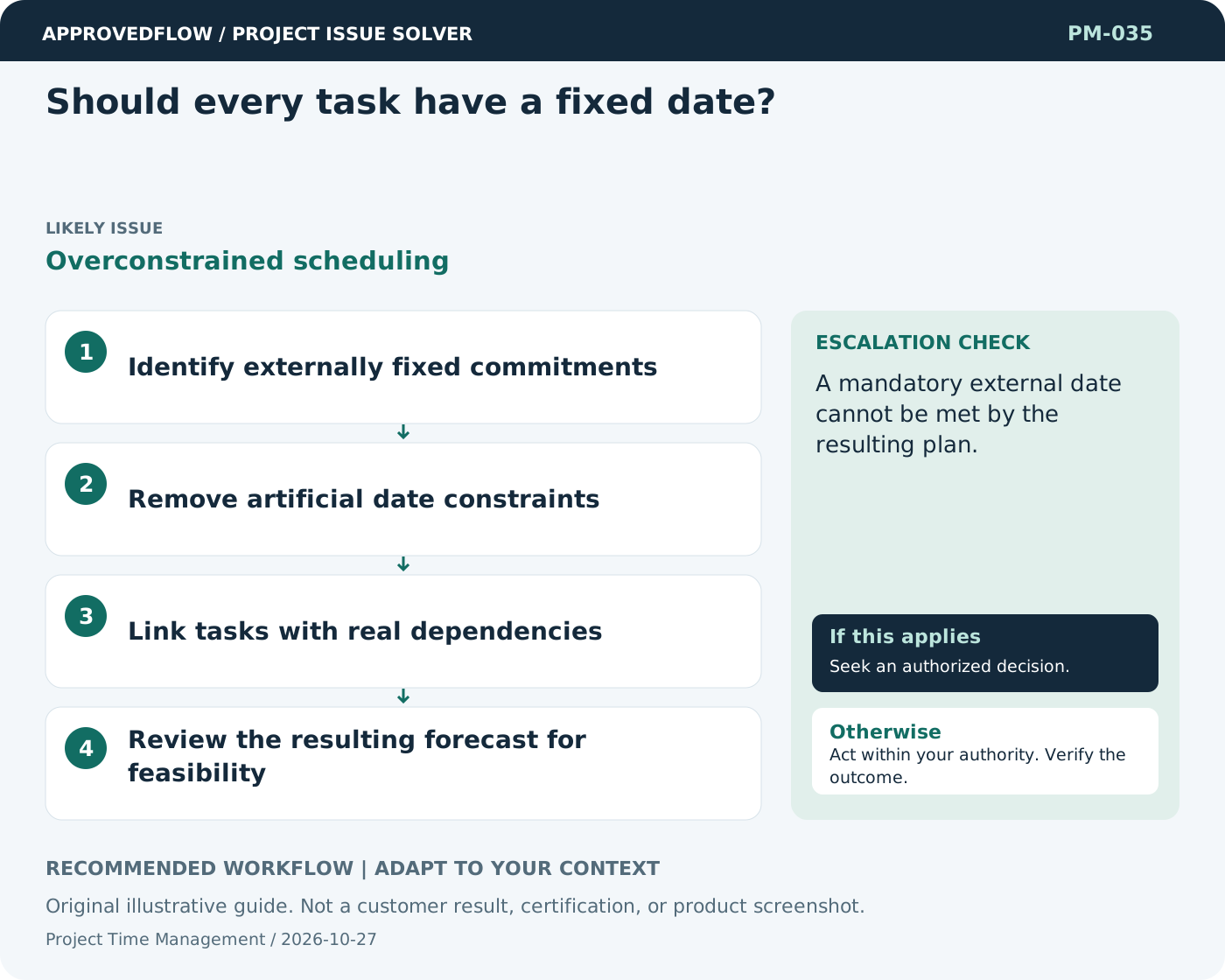
Overconstrained schedulingUse fixed dates for genuine external constraints, not as substitutes for dependency logic. Let ordinary task dates respond to remaining work, calendars, and predecessor changes.
What to do now
- Identify externally fixed commitments
- Remove artificial date constraints
- Link tasks with real dependencies
- Review the resulting forecast for feasibility
When to escalate
Escalate when
A mandatory external date cannot be met by the resulting plan.
Who decides
The project manager and relevant commitment owner
Example
A permit deadline stays fixed while internal preparation tasks move according to their actual sequence.
Mistake to avoid
Locking every task date to preserve an attractive chart.
Prevent a repeat
Compare forecast versus actual results for comparable tasks, separating effort, elapsed time, waiting and scope change.
Suggested ApprovedFlow setup
- Tasks
- Timesheets
- Resources
Keep planned dates and assumptions with the affected task, compare recorded actuals, and attach the revised forecast for review. See the platform
Related cases
- Every task is on time, but the project is late. What are we missing?Missing schedule relationships
- Our team repeatedly starts work before dependencies are ready. How do we stop rework?Premature task starts
- How do we manage fixed regulatory dates with iterative delivery?Fixed-date adaptive planning
- How do we manage a fixed launch date with uncertain technical work?Uncertainty near a hard date