AI translates our project guidance badly in Arabic. How should we release it?
Unreviewed localized AI outputEvaluate the actual language and domain terminology with qualified reviewers and realistic users. Check meaning, right-to-left presentation, names, dates, and action wording. Release only the language experiences that meet the agreed quality criteria rather than hiding English content behind translated labels.
What to do now
- Collect representative Arabic tasks and terms
- Review meaning with qualified language experts
- Test right-to-left screens and action clarity
- Correct failures before enabling the language
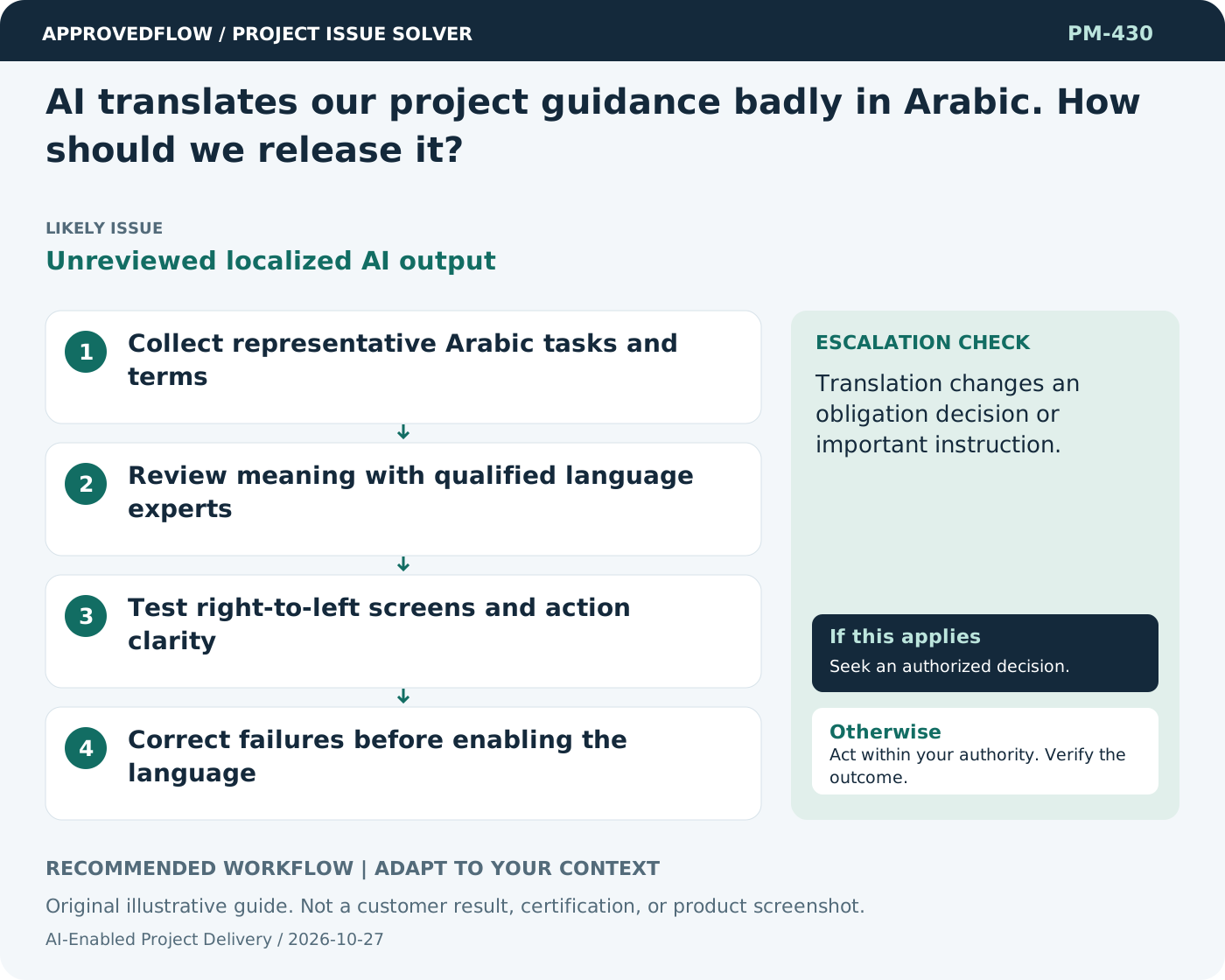
When to escalate
Translation changes an obligation decision or important instruction.
The AI service owner and relevant authorized reviewer
Example
A reviewer corrects an Arabic term that wrongly turns a recommendation into a mandatory instruction.
Mistake to avoid
Assuming a translated menu means the entire workflow is localized.
Prevent a repeat
Re-evaluate after changes to models, prompts, tools or source data; keep important decisions accountable to people.
Suggested ApprovedFlow setup
- Tasks
- Documents
- Approvals
Track evaluation and review tasks, and keep approved evidence with the work; do not claim the platform provides an unverified AI agent or automated diagnosis. See the platform
Related cases
- We have no owner after the AI pilot succeeds. What should happen before launch?Missing AI service ownership
- The agent changed many records incorrectly. How do we recover?Insufficient action traceability and rollback
- How do we distinguish quality assurance from quality control?Process-versus-output checks
- How do we identify projects that should be stopped?Unreviewed continuation