How do we decide which tests to automate first?
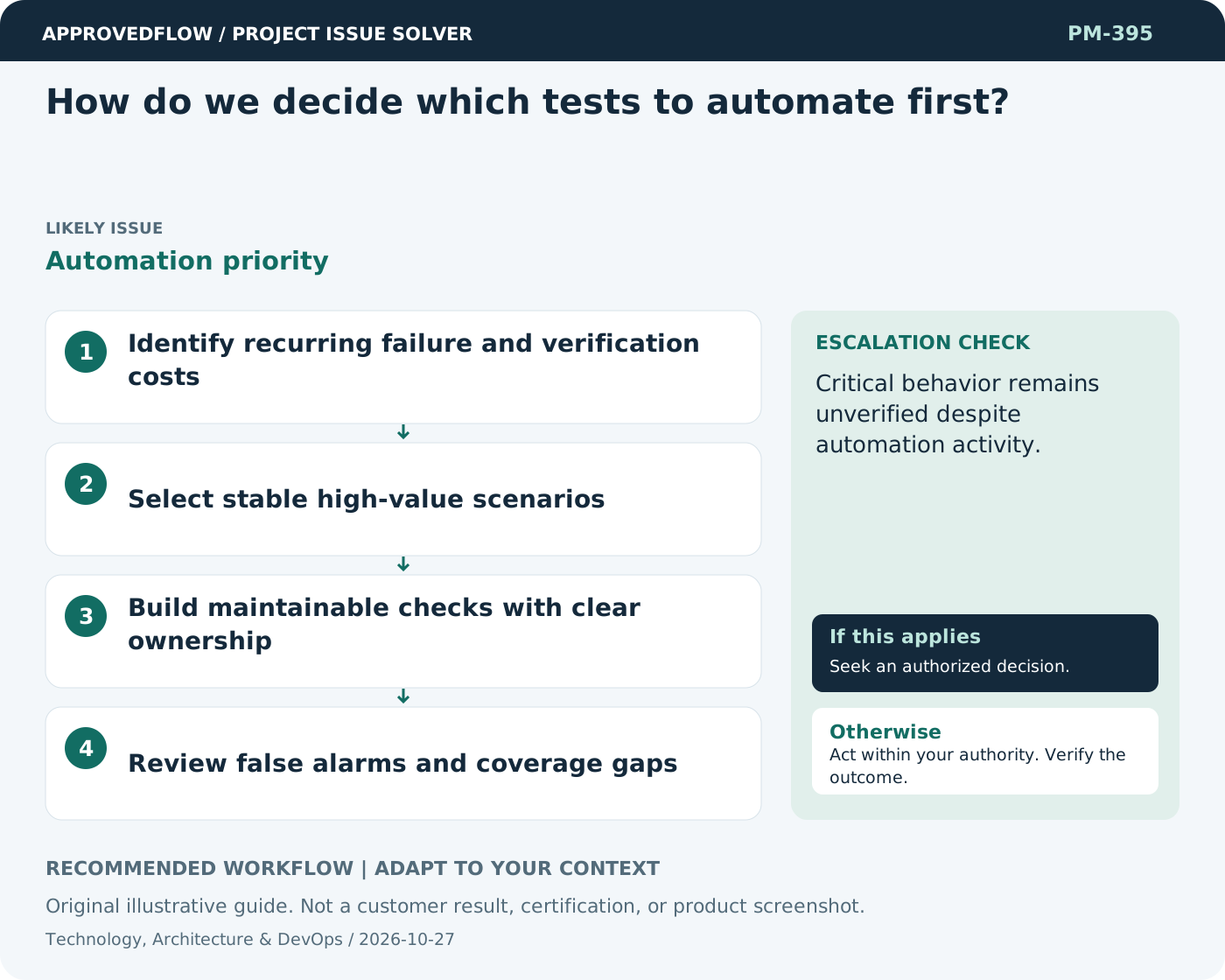
Automation priorityPrioritize repeatable high-consequence checks that provide useful feedback and can be maintained reliably. Automation should reduce risk or effort, not merely create an impressive test count.
What to do now
- Identify recurring failure and verification costs
- Select stable high-value scenarios
- Build maintainable checks with clear ownership
- Review false alarms and coverage gaps
When to escalate
Critical behavior remains unverified despite automation activity.
The technical owner and authorized release decision maker
Example
A team automates transaction reconciliation before a rarely used cosmetic interaction.
Mistake to avoid
Automating unstable low-value scenarios while ignoring important manual gaps.
Prevent a repeat
Review real execution evidence and maintainability alongside feature completion; do not treat an unrun test as passed.
Suggested ApprovedFlow setup
- Tasks
- Documents
- Approvals
Track delivery tasks and attach engineering evidence; keep source control, build execution and technical controls in their actual engineering systems. See the platform
Related cases
- Our test suite passes, but production failures continue. What should we inspect?Test relevance gap
- The team chooses a technology nobody can support. How should we decide?Operational capability mismatch
- A report needs manual copying from several systems. What should we automate first?Fragile reporting pipeline
- Our issue priorities change depending on who complains. How can we be fair?Influence-driven issue priority