Our rolling plan changes weekly. Is that poor planning?
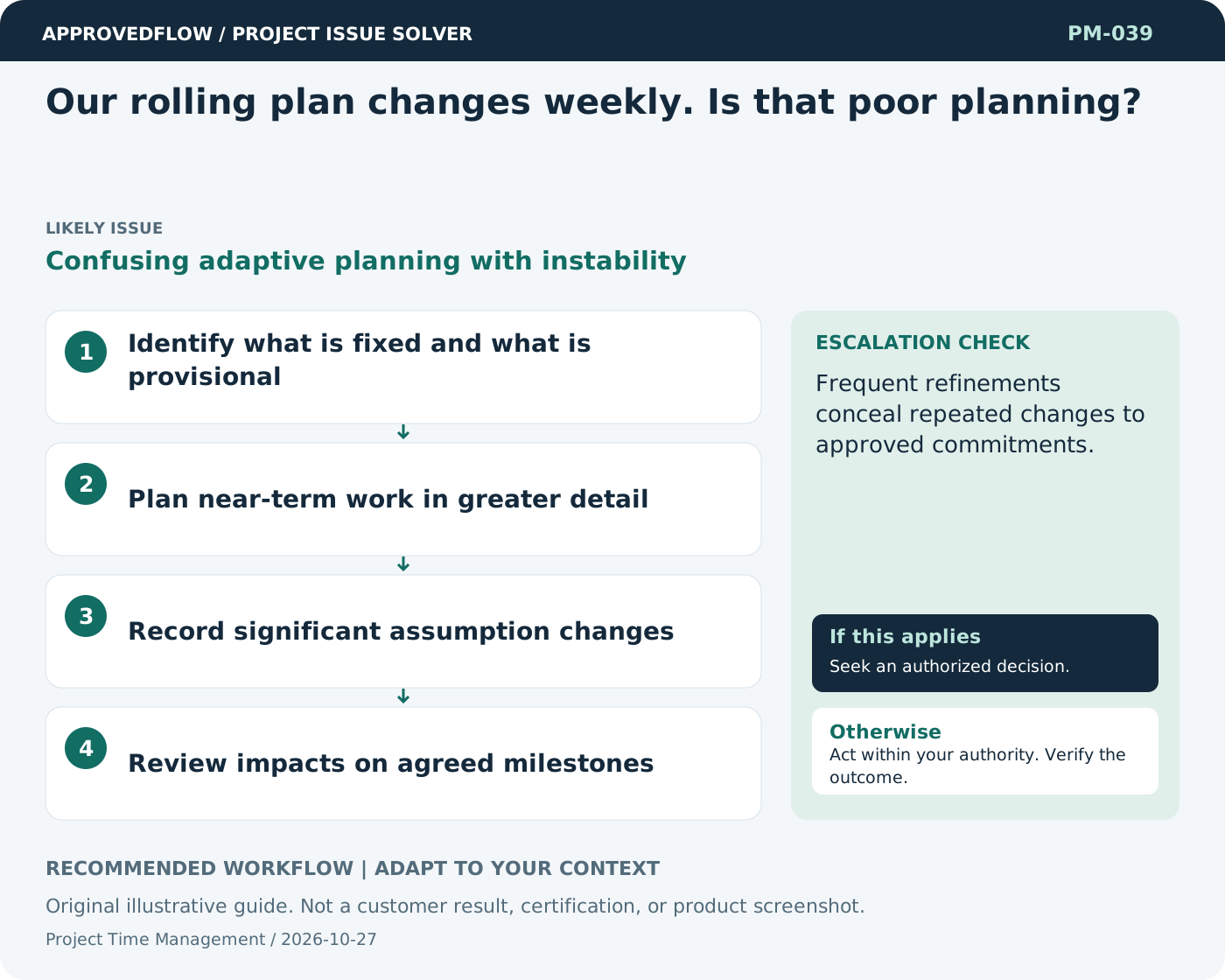
Confusing adaptive planning with instabilityDetail should increase as uncertainty decreases, but the purpose and decision history should remain clear. Distinguish evidence-based refinement from uncontrolled changes to commitments.
What to do now
- Identify what is fixed and what is provisional
- Plan near-term work in greater detail
- Record significant assumption changes
- Review impacts on agreed milestones
When to escalate
Escalate when
Frequent refinements conceal repeated changes to approved commitments.
Who decides
The project manager and relevant commitment owner
Example
A team refines next month's tasks while keeping the release objective and approval boundaries visible.
Mistake to avoid
Pretending distant uncertain work can be planned with daily precision.
Prevent a repeat
Compare forecast versus actual results for comparable tasks, separating effort, elapsed time, waiting and scope change.
Suggested ApprovedFlow setup
- Tasks
- Timesheets
- Resources
Keep planned dates and assumptions with the affected task, compare recorded actuals, and attach the revised forecast for review. See the platform
Related cases
- A supplier date is a promise, not a supported plan. How should we schedule it?Unreliable external forecast
- The deadline never changes, but the remaining work keeps growing. What should we show?Forecast-baseline disconnect
- How do we manage fixed regulatory dates with iterative delivery?Fixed-date adaptive planning
- The database migration has no rollback plan. Can we proceed?Unsafe migration readiness