How should we report a finish-date range instead of one date?
Uncertainty communicationPresent the forecast range with its assumptions and decision implications. Do not attach statistical confidence labels unless the estimation method and data actually support them.
What to do now
- Explain the sources of uncertainty
- Build plausible completion scenarios
- Show the decisions that narrow the range
- Refresh the range when evidence changes
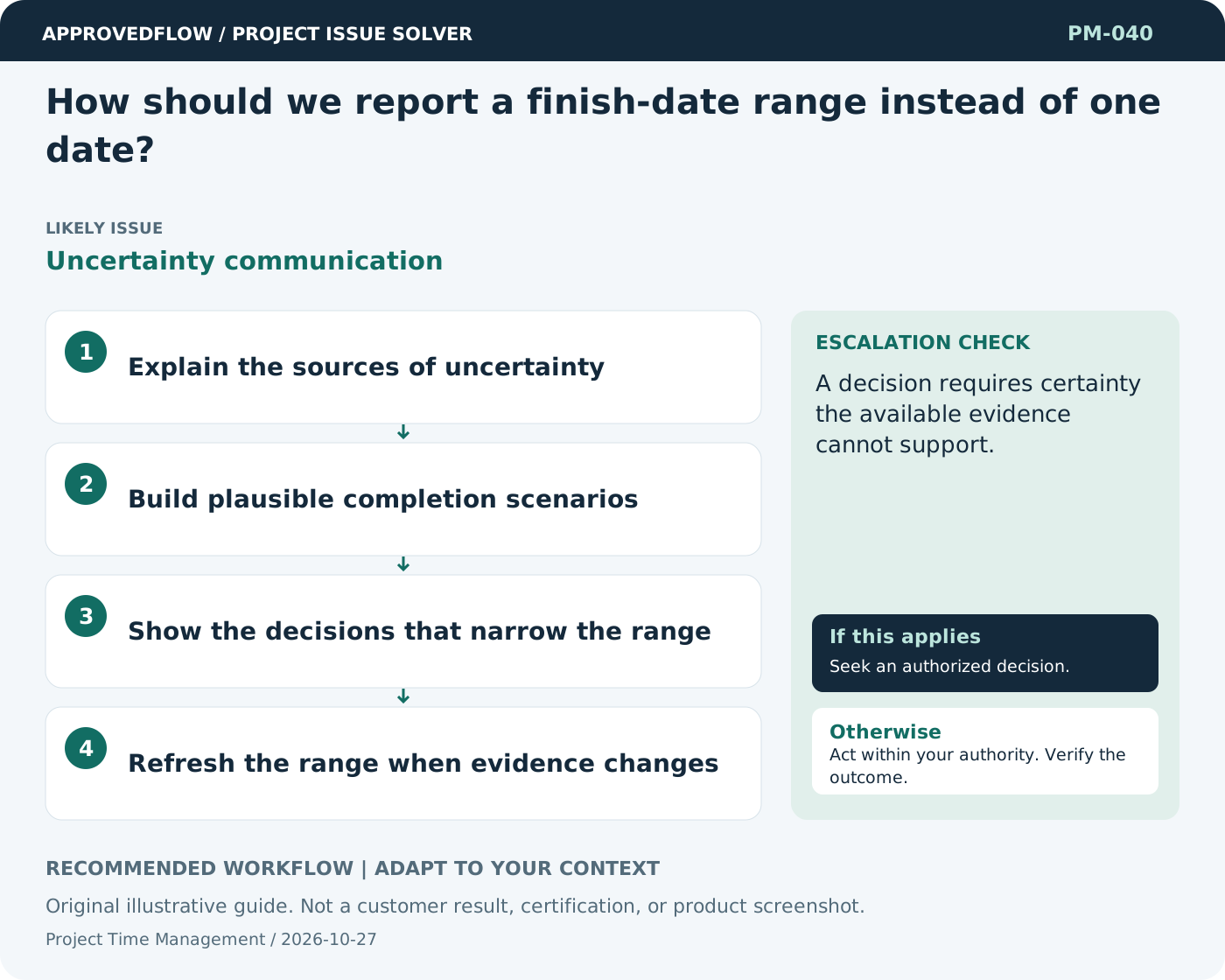
When to escalate
A decision requires certainty the available evidence cannot support.
The project manager and relevant commitment owner
Example
A team reports completion between two dates depending on supplier access, without pretending the range comes from a statistical model.
Mistake to avoid
Calling a guessed range a ninety-five-percent confidence interval.
Prevent a repeat
Compare forecast versus actual results for comparable tasks, separating effort, elapsed time, waiting and scope change.
Suggested ApprovedFlow setup
- Tasks
- Timesheets
- Resources
Keep planned dates and assumptions with the affected task, compare recorded actuals, and attach the revised forecast for review. See the platform
Related cases
- The schedule has no buffer. Should we add one?Unmanaged schedule uncertainty
- Should we add more people to finish a late task faster?Unproven schedule compression
- Our project depends on an external approval date we cannot control. What should we do?External decision uncertainty
- The procurement process will finish after the required start date. What can we do?Procurement lead-time mismatch