Should we add more people to finish a late task faster?
Unproven schedule compressionAdditional people help only when work can be divided and onboarding will not consume the expected gain. Test the bottleneck and coordination overhead before changing staffing.
What to do now
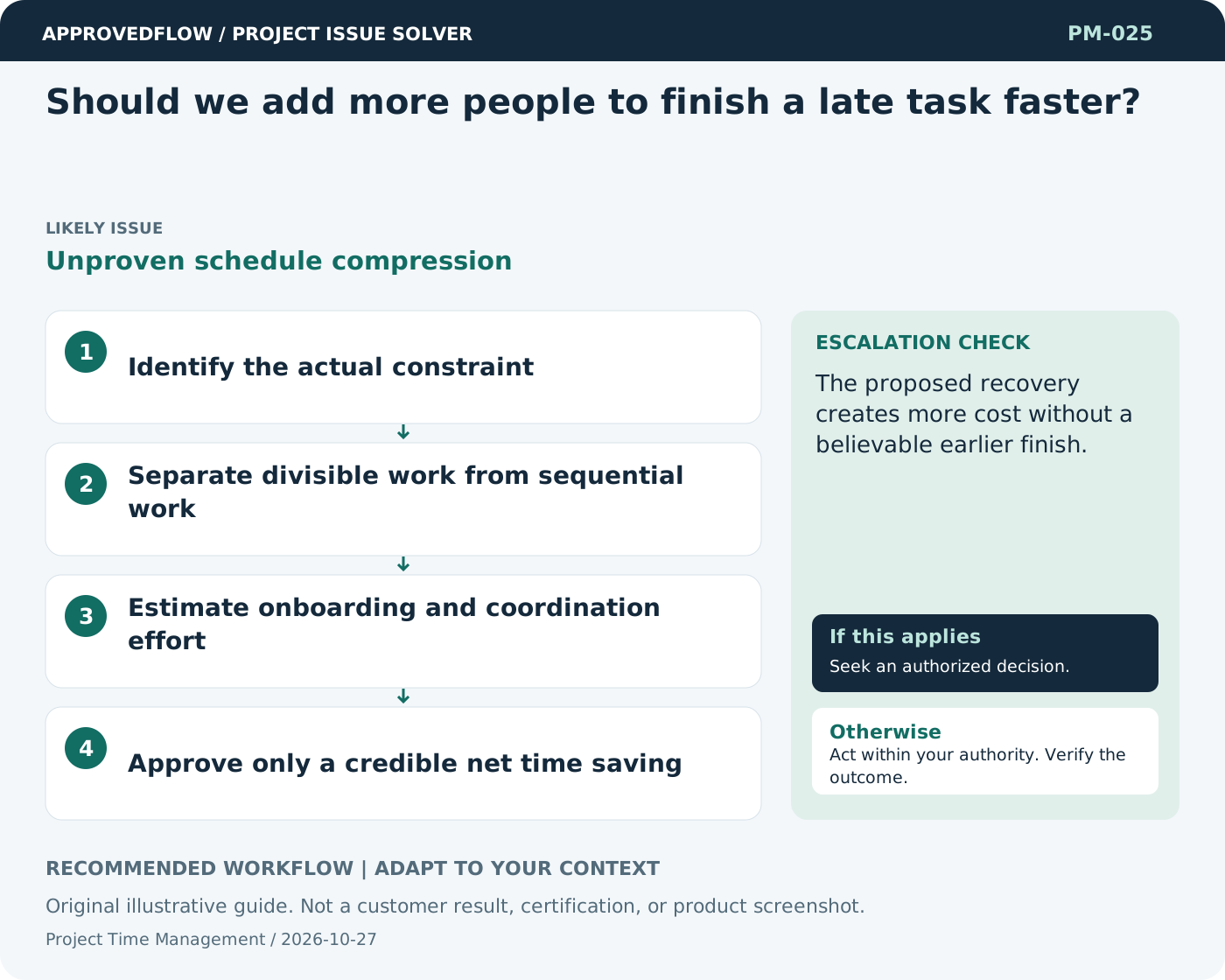
- Identify the actual constraint
- Separate divisible work from sequential work
- Estimate onboarding and coordination effort
- Approve only a credible net time saving
When to escalate
Escalate when
The proposed recovery creates more cost without a believable earlier finish.
Who decides
The project manager and relevant commitment owner
Example
Two extra testers can run independent scenarios, but they cannot shorten a sequential regulatory review.
Mistake to avoid
Assuming twice the people means half the duration.
Prevent a repeat
Compare forecast versus actual results for comparable tasks, separating effort, elapsed time, waiting and scope change.
Suggested ApprovedFlow setup
- Tasks
- Timesheets
- Resources
Keep planned dates and assumptions with the affected task, compare recorded actuals, and attach the revised forecast for review. See the platform
Related cases
- Every task is on time, but the project is late. What are we missing?Missing schedule relationships
- The schedule has no buffer. Should we add one?Unmanaged schedule uncertainty
- We have more approved projects than people to deliver them. What should leadership do?Portfolio overload
- The procurement process will finish after the required start date. What can we do?Procurement lead-time mismatch