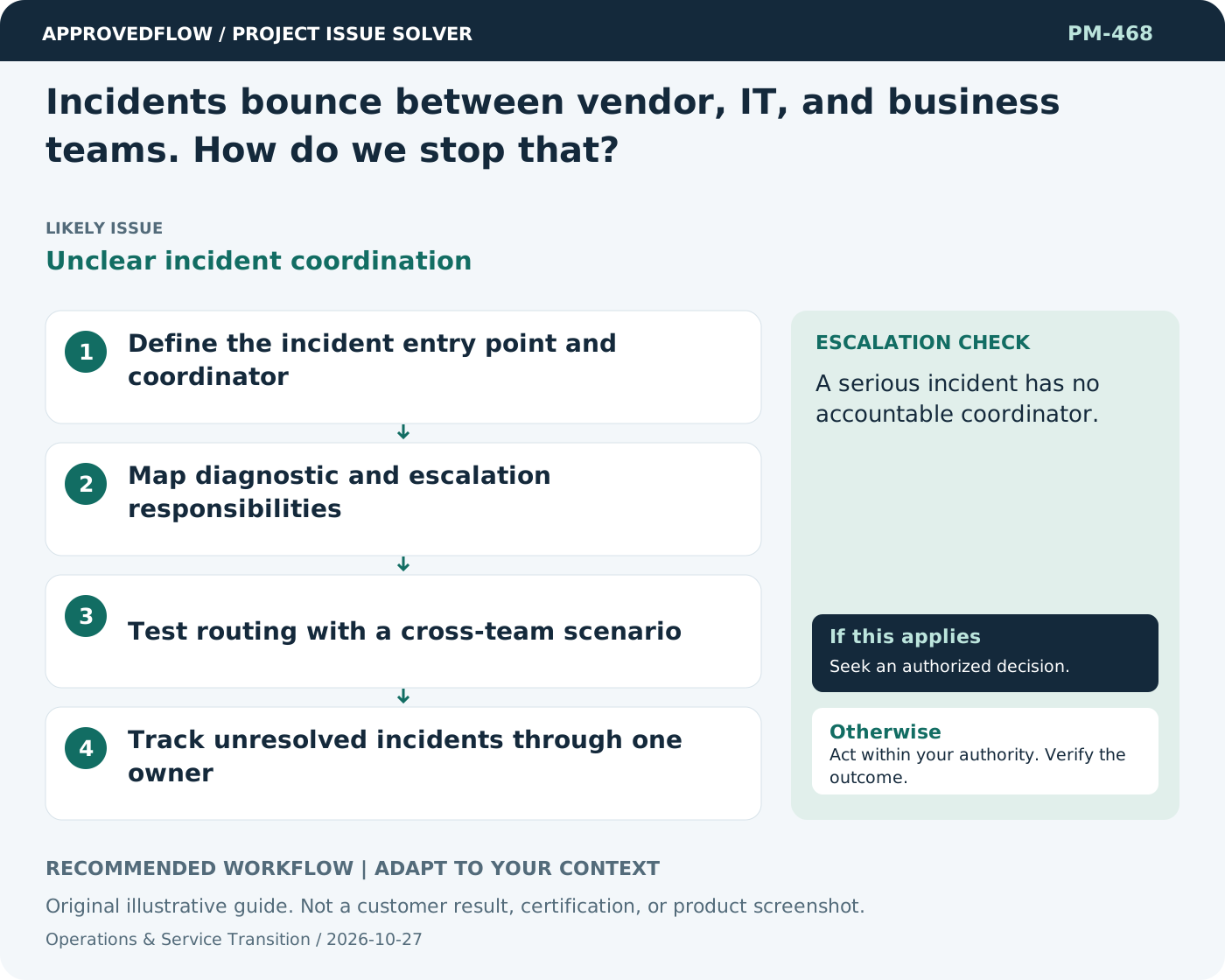
Incidents bounce between vendor, IT, and business teams. How do we stop that?
Unclear incident coordinationAssign one incident coordinator and a clear routing model, even when several teams contribute to diagnosis. Keep ownership of progress and communication separate from the current technical hypothesis. A user should not have to prove which supplier is responsible before receiving help.
What to do now
- Define the incident entry point and coordinator
- Map diagnostic and escalation responsibilities
- Test routing with a cross-team scenario
- Track unresolved incidents through one owner
When to escalate
A serious incident has no accountable coordinator.
The service owner and authorized operational decision maker
Example
The service desk retains coordination while the vendor investigates an integration error.
Mistake to avoid
Closing a ticket simply because another team might be responsible.
Prevent a repeat
Test whether receiving teams can operate and recover the service without depending on informal project-team support.
Suggested ApprovedFlow setup
- Tasks
- Documents
- Approvals
Keep handover tasks, operating evidence and the acceptance decision linked to the project while retaining monitoring and incident control in the actual service tools. See the platform
Related cases
- Business data errors continue after launch. Who should fix them?Undefined operational data ownership
- Vendor support excludes the integration we depend on. What should we do?Support boundary gap
- Who should perform user acceptance testing?Unclear business verification ownership
- How do we schedule integration between teams with different iteration lengths?Cadence integration mismatch