Who owns integration in a hybrid program?
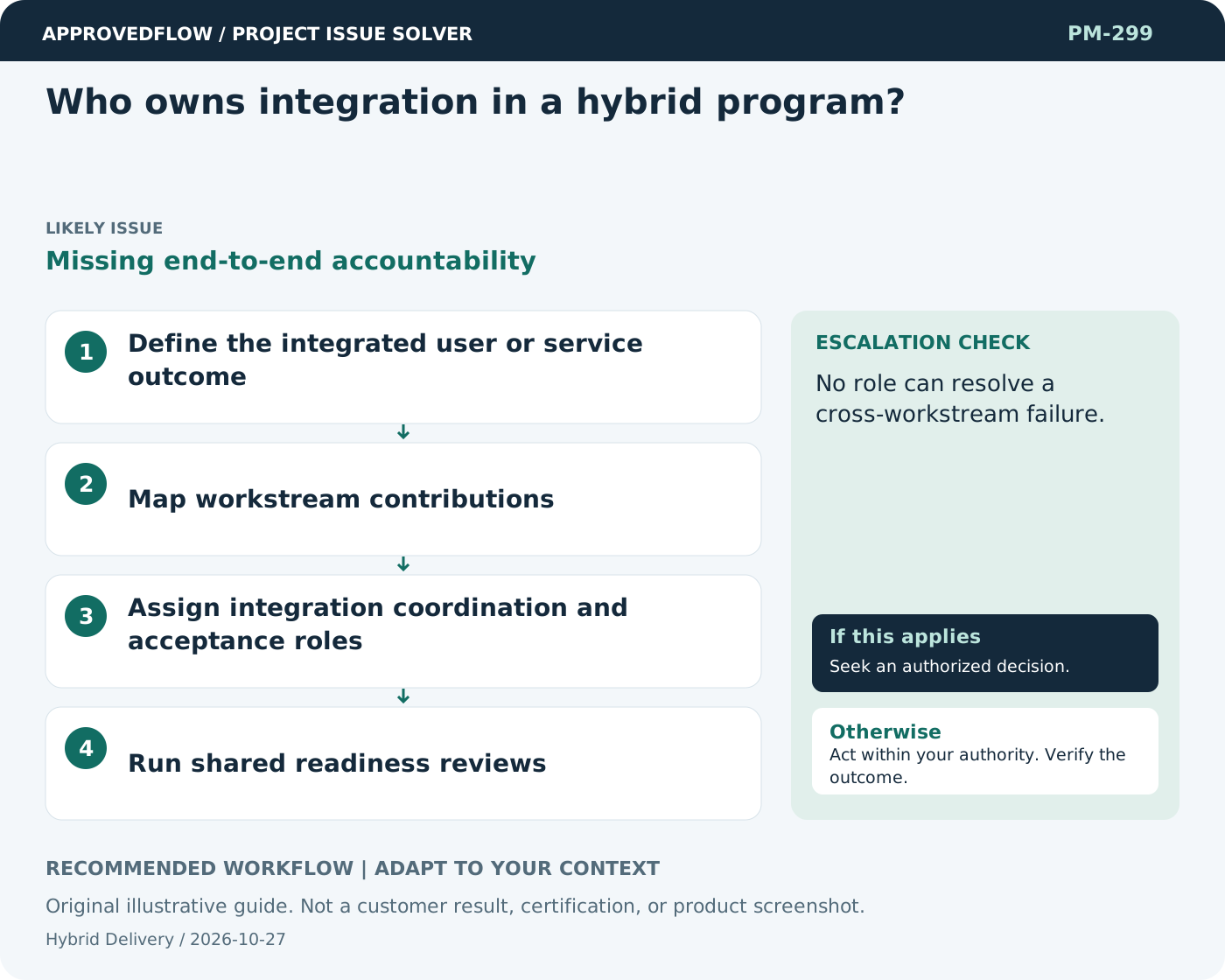
Missing end-to-end accountabilityAssign explicit responsibility for the integrated outcome and its verification. Individual workstream owners can remain accountable for their outputs while one coordinating role manages cross-boundary readiness.
What to do now
- Define the integrated user or service outcome
- Map workstream contributions
- Assign integration coordination and acceptance roles
- Run shared readiness reviews
When to escalate
Escalate when
No role can resolve a cross-workstream failure.
Who decides
The delivery owner and relevant governance authority
Example
A program lead coordinates the end-to-end enrollment journey across facilities, systems, and operations.
Mistake to avoid
Assuming integration will emerge from independent workstream completion.
Prevent a repeat
Check whether governance decisions use real delivery evidence rather than forcing incompatible reporting rituals.
Suggested ApprovedFlow setup
- Projects
- Tasks
- Documents
- Approvals
Keep decision milestones and iterative task work connected, with explicit evidence required at each approved gate. See the platform
Related cases
- How do stage gates work with iterative development?Evidence-based hybrid governance
- How do we decide whether a hybrid approach is actually helping?Unexamined method value
- Who owns benefits after the project team leaves?Unassigned benefits accountability
- The project ends before its benefits can be measured. Who owns the result?Missing post-project benefits ownership