How do stage gates work with iterative development?
Evidence-based hybrid governanceUse gates to assess investment, readiness, and risk using accumulated delivery evidence. Avoid requiring all learning to stop or all requirements to freeze merely because a gate exists.
What to do now
- Define the gate's decision purpose
- Collect evidence from iterations
- Identify remaining uncertainty and options
- Authorize the next bounded stage
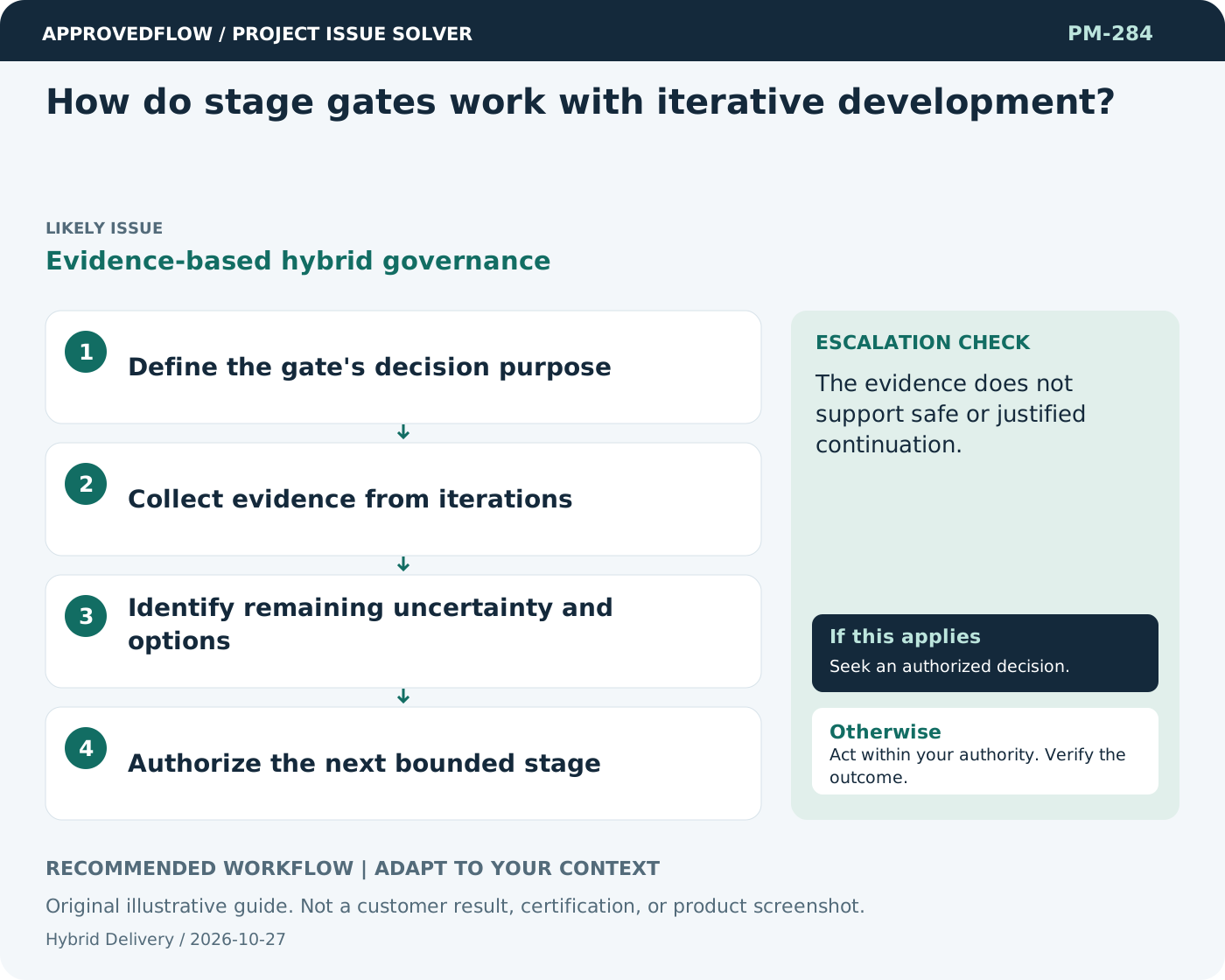
When to escalate
Escalate when
The evidence does not support safe or justified continuation.
Who decides
The delivery owner and relevant governance authority
Example
A gate reviews validated user journeys and unresolved risks before approving a wider rollout.
Mistake to avoid
Turning each iteration into a full investment committee meeting.
Prevent a repeat
Check whether governance decisions use real delivery evidence rather than forcing incompatible reporting rituals.
Suggested ApprovedFlow setup
- Projects
- Tasks
- Documents
- Approvals
Keep decision milestones and iterative task work connected, with explicit evidence required at each approved gate. See the platform
Related cases
- How can we preserve documentation without slowing iterative work?Documentation proportionality
- How do we manage fixed regulatory dates with iterative delivery?Fixed-date adaptive planning
- Our stage gates are automatic approvals. What should change?Ceremonial stage gates
- A small project blocks a major program. How should priority change?Dependency-based portfolio priority