The client changes their mind repeatedly. How do we manage the relationship?
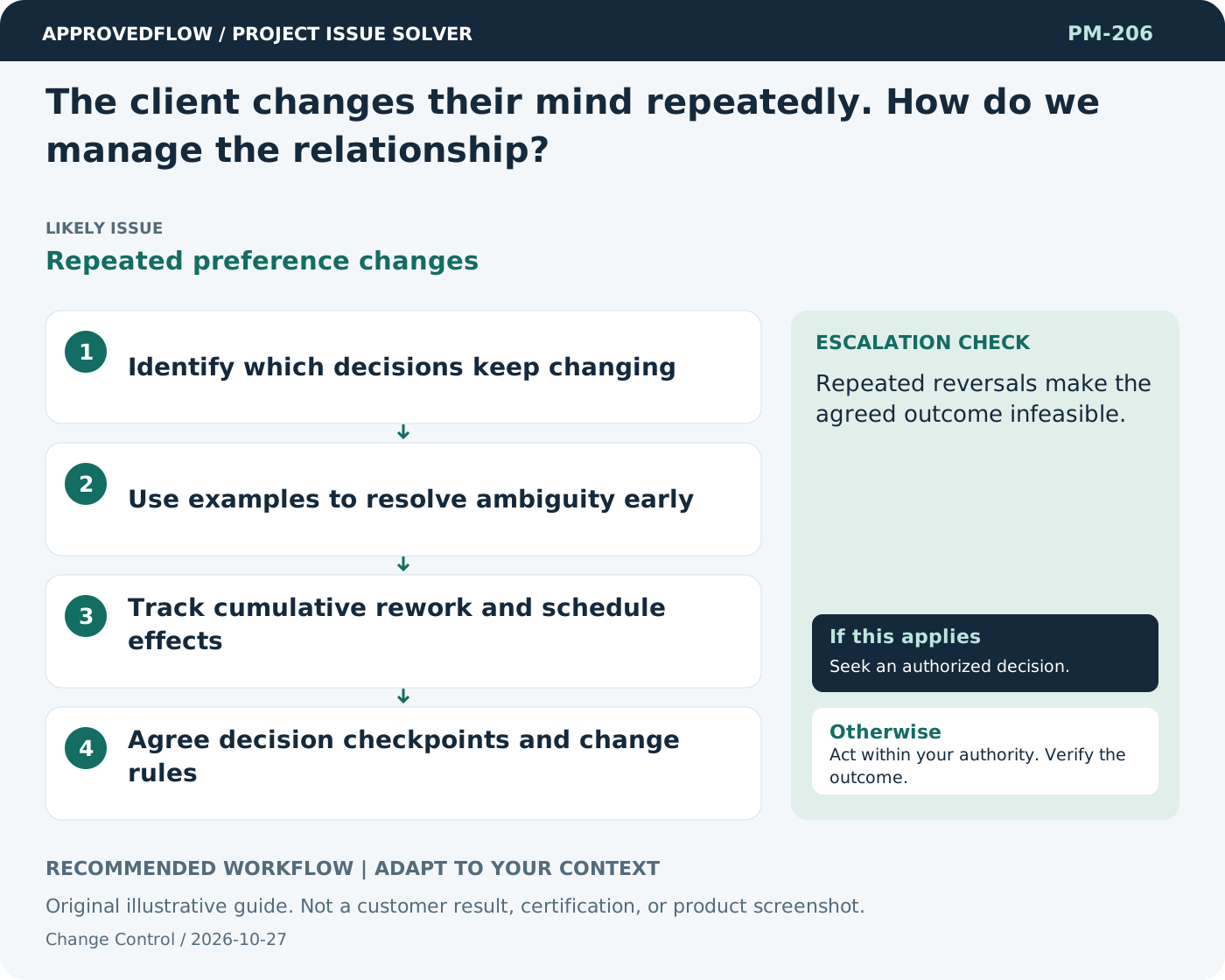
Repeated preference changesUse early examples to clarify decisions and make the cumulative consequences visible. Preserve a constructive relationship while requiring explicit choices about rework and commitments.
What to do now
- Identify which decisions keep changing
- Use examples to resolve ambiguity early
- Track cumulative rework and schedule effects
- Agree decision checkpoints and change rules
When to escalate
Escalate when
Repeated reversals make the agreed outcome infeasible.
Who decides
The authorized change decision maker
Example
A design team obtains approval of a representative page before applying the pattern throughout the site.
Mistake to avoid
Accepting every reversal without showing what it displaces.
Prevent a repeat
Compare delivered changes with authorized decisions and keep the current baseline distinguishable from earlier versions.
Suggested ApprovedFlow setup
- Documents
- Approvals
- Tasks
Keep the change request, impact assessment and recorded decision together; update affected tasks only after the appropriate authorization. See the platform
Related cases
- How do we manage changes in a fixed-price contract?Commercial change boundary
- A regulatory requirement changes during the project. How should we react?External requirement change
- Our sprint goal changes every few days. How should we respond?Unstable sprint purpose
- Quality reviews find the same defects repeatedly. How do we improve prevention?Repeated defect causes