Our AI feature works in demos but users do not trust it. What should change?
Poorly explained assistance and recoveryObserve actual users to identify whether distrust comes from errors, unclear evidence, unpredictable actions, or inability to correct output. Show what the system used, what it proposes, and what the user controls. Improve reliability and recovery instead of adding unsupported confidence badges.
What to do now
- Observe real tasks and failure points
- Expose relevant evidence and action boundaries
- Make correction and rejection straightforward
- Measure task success after the changes
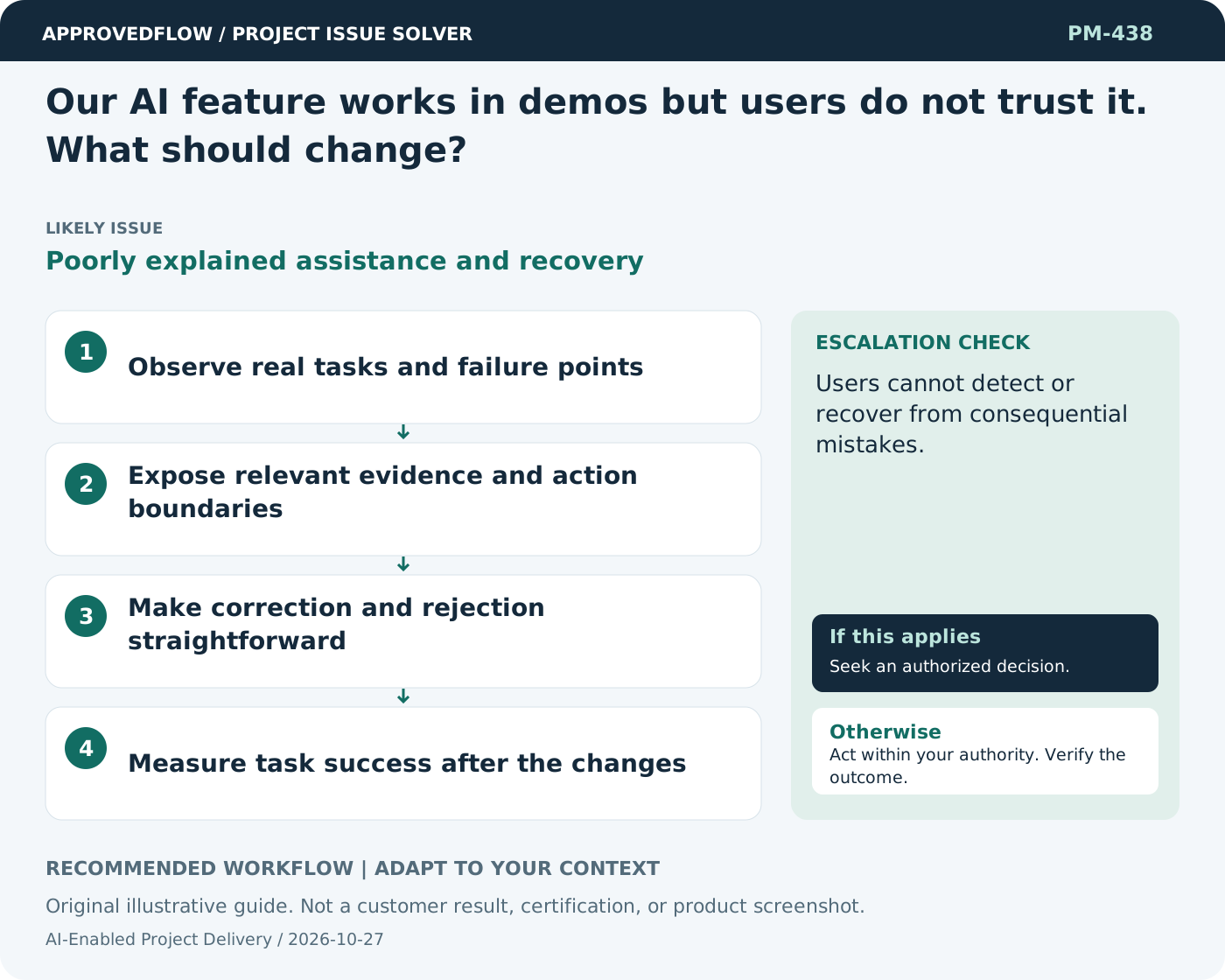
When to escalate
Users cannot detect or recover from consequential mistakes.
The AI service owner and relevant authorized reviewer
Example
Users trust a draft more when they can inspect source records and reject individual suggested changes.
Mistake to avoid
Displaying a confidence percentage that has not been calibrated.
Prevent a repeat
Re-evaluate after changes to models, prompts, tools or source data; keep important decisions accountable to people.
Suggested ApprovedFlow setup
- Tasks
- Documents
- Approvals
Track evaluation and review tasks, and keep approved evidence with the work; do not claim the platform provides an unverified AI agent or automated diagnosis. See the platform
Related cases
- We want to prove our AI feature works. What should we test?Missing task-specific evaluation
- AI usage costs are rising faster than adoption. What should we examine?Uncontrolled inference consumption
- Developers say the feature works, but users cannot complete the process. What is missing?Component success without user journey
- A feature is popular with executives but not users. How do we evaluate it?Influence-driven product value