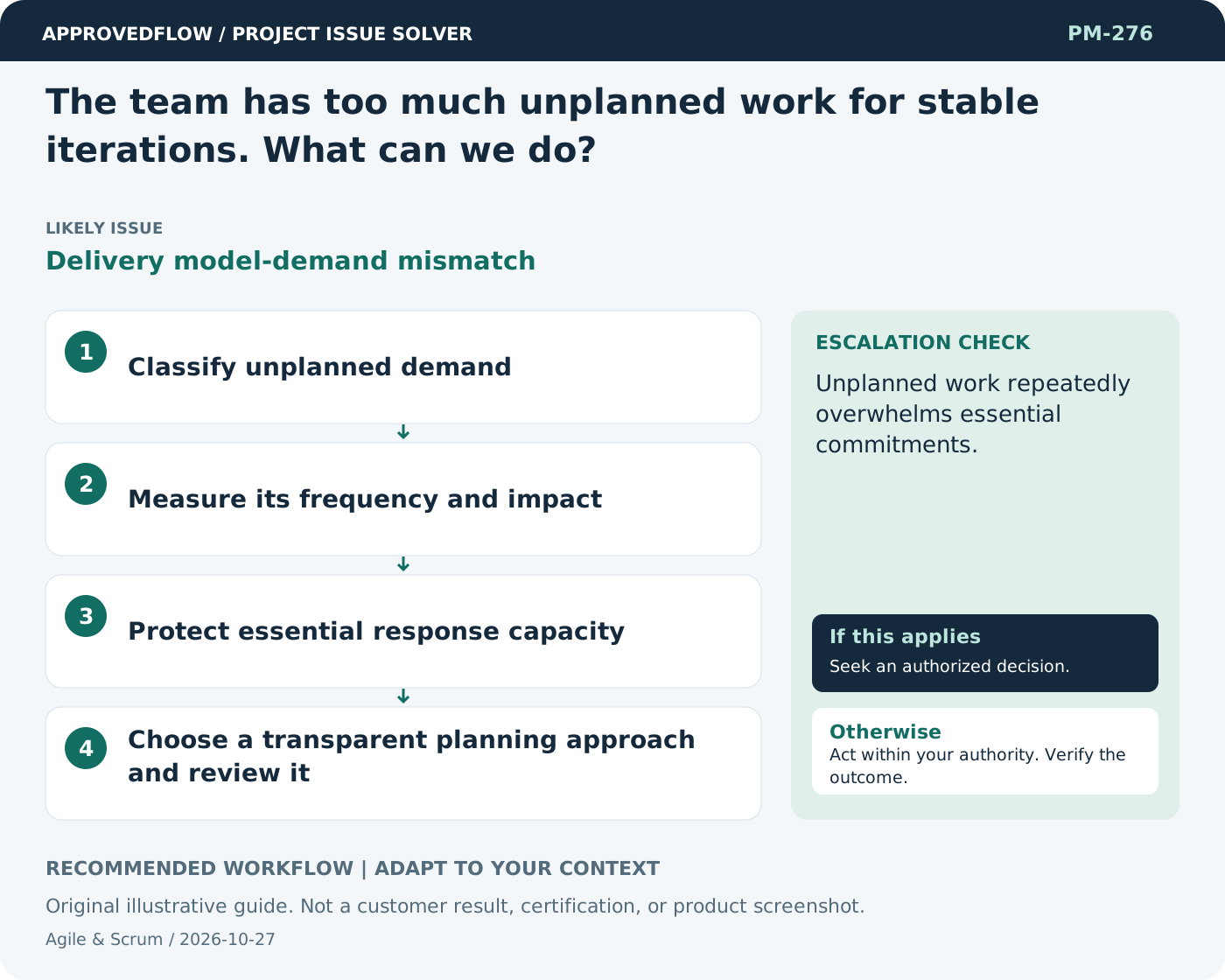
The team has too much unplanned work for stable iterations. What can we do?
Delivery model-demand mismatchMeasure the unplanned demand and adapt capacity and work-management practices to the actual service context. A flow-based approach or explicit reserve may fit better than repeated unrealistic commitments.
What to do now
- Classify unplanned demand
- Measure its frequency and impact
- Protect essential response capacity
- Choose a transparent planning approach and review it
When to escalate
Escalate when
Unplanned work repeatedly overwhelms essential commitments.
Who decides
The relevant Scrum accountability or delivery owner
Example
A support-heavy team manages work in a controlled flow while retaining explicit improvement goals.
Mistake to avoid
Pretending incident demand is an occasional exception when it is routine.
Prevent a repeat
Inspect useful outcomes and feedback; apply Scrum-specific rules only when the team is actually using Scrum.
Suggested ApprovedFlow setup
- Tasks
- Documents
- Resources
Represent agreed work and evidence with enabled task features; do not imply native Scrum automation or certified Scrum compliance. See the platform
Related cases
- Our work items are too large to finish in an iteration. How should we split them?Oversized delivery batches
- We carry unfinished work into every sprint. What should we inspect?Persistent delivery overcommitment
- Our resource plan ignores support work. What should change?Missing operational demand
- How do we plan capacity for unpredictable incidents?Variable demand planning