How should we handle a risk we cannot prevent?
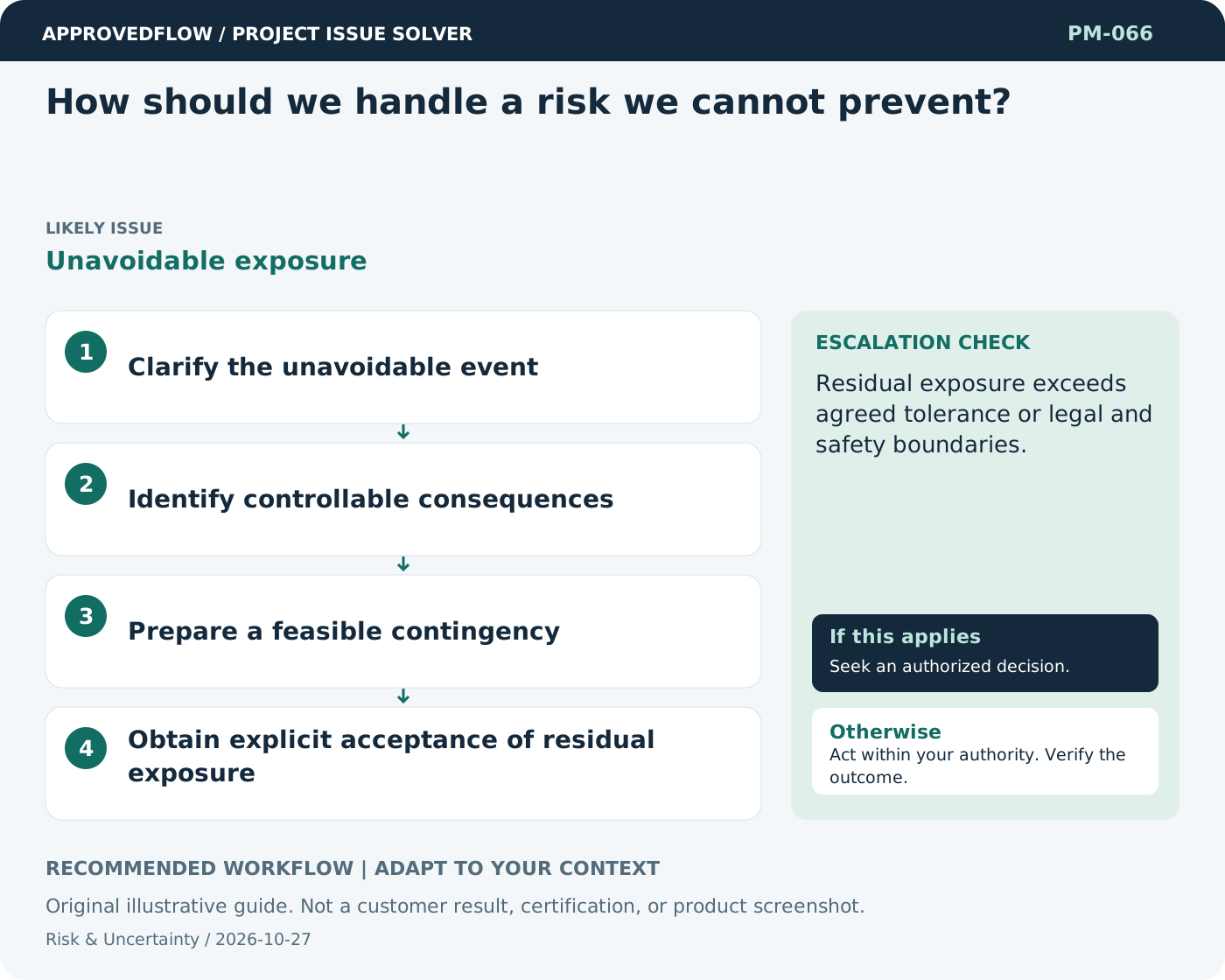
Unavoidable exposureChoose a deliberate response such as reducing impact, preparing contingency, transferring a suitable element, or accepting exposure within authority. Inability to prevent an event does not remove the need to prepare.
What to do now
- Clarify the unavoidable event
- Identify controllable consequences
- Prepare a feasible contingency
- Obtain explicit acceptance of residual exposure
When to escalate
Escalate when
Residual exposure exceeds agreed tolerance or legal and safety boundaries.
Who decides
The accountable risk owner
Example
A weather-sensitive activity keeps a fallback sequence and a decision trigger even though the weather cannot be controlled.
Mistake to avoid
Writing accepted without naming who accepted what.
Prevent a repeat
Review whether response tasks and trigger conditions remain appropriate as the project changes.
Suggested ApprovedFlow setup
- Documents
- Tasks
- Approvals
Store the risk assessment as a controlled project document and assign response tasks; do not assume a native risk engine is enabled. See the platform
Related cases
- Several small risks share the same cause. How do we manage them?Correlated risk exposure
- A low-probability risk could be catastrophic. How do we assess it?Severe low-frequency exposure
- How do we handle exchange-rate uncertainty in a project budget?Currency exposure
- We are closing with residual risks. What must be transferred?Unowned residual risk exposure