The team rates every risk as high. How can we prioritize?
Undifferentiated risk assessmentAgree consistent probability and impact descriptions, then discuss evidence rather than labels. Use the assessment to select actions, not to produce a visually alarming register.
What to do now
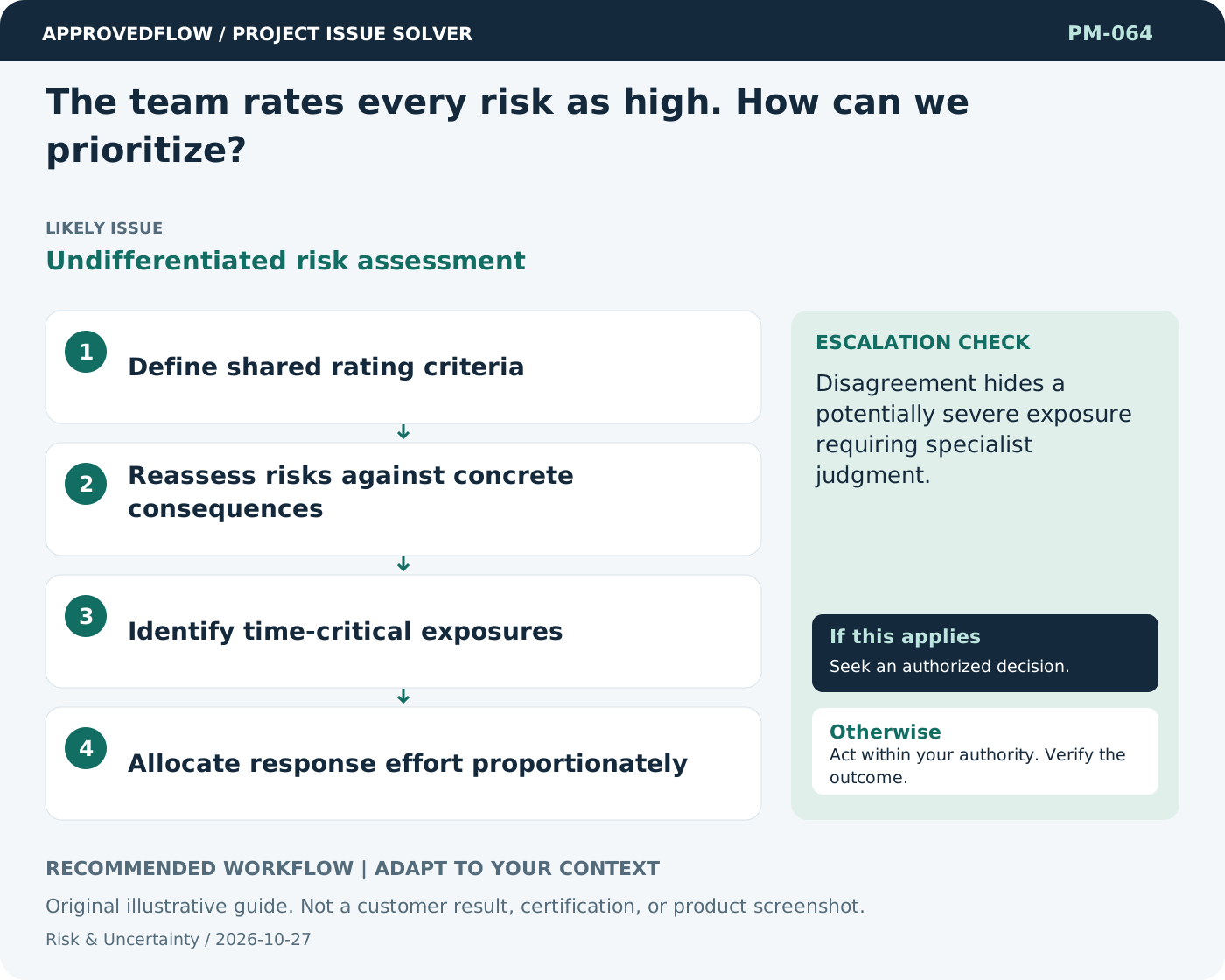
- Define shared rating criteria
- Reassess risks against concrete consequences
- Identify time-critical exposures
- Allocate response effort proportionately
When to escalate
Escalate when
Disagreement hides a potentially severe exposure requiring specialist judgment.
Who decides
The accountable risk owner
Example
A minor reporting delay is separated from a risk that could stop the entire service.
Mistake to avoid
Multiplying arbitrary numbers and treating the result as precise science.
Prevent a repeat
Review whether response tasks and trigger conditions remain appropriate as the project changes.
Suggested ApprovedFlow setup
- Documents
- Tasks
- Approvals
Store the risk assessment as a controlled project document and assign response tasks; do not assume a native risk engine is enabled. See the platform
Related cases
- We discover the same risk in every project. How do we stop repeating it?Uncorrected systemic risk
- How do we close a risk properly?Unsupported risk closure
- Every project is marked strategic. How do we prioritize meaningfully?Unselective strategic classification
- How do we prioritize benefits that are hard to express in money?Narrow value assessment