How do we choose between a quick win and a foundational improvement?
Value timing trade-offCompare near-term benefit with dependencies, risk reduction, and future capability. A visible quick win may be useful, but it should not repeatedly displace essential foundational work.
What to do now
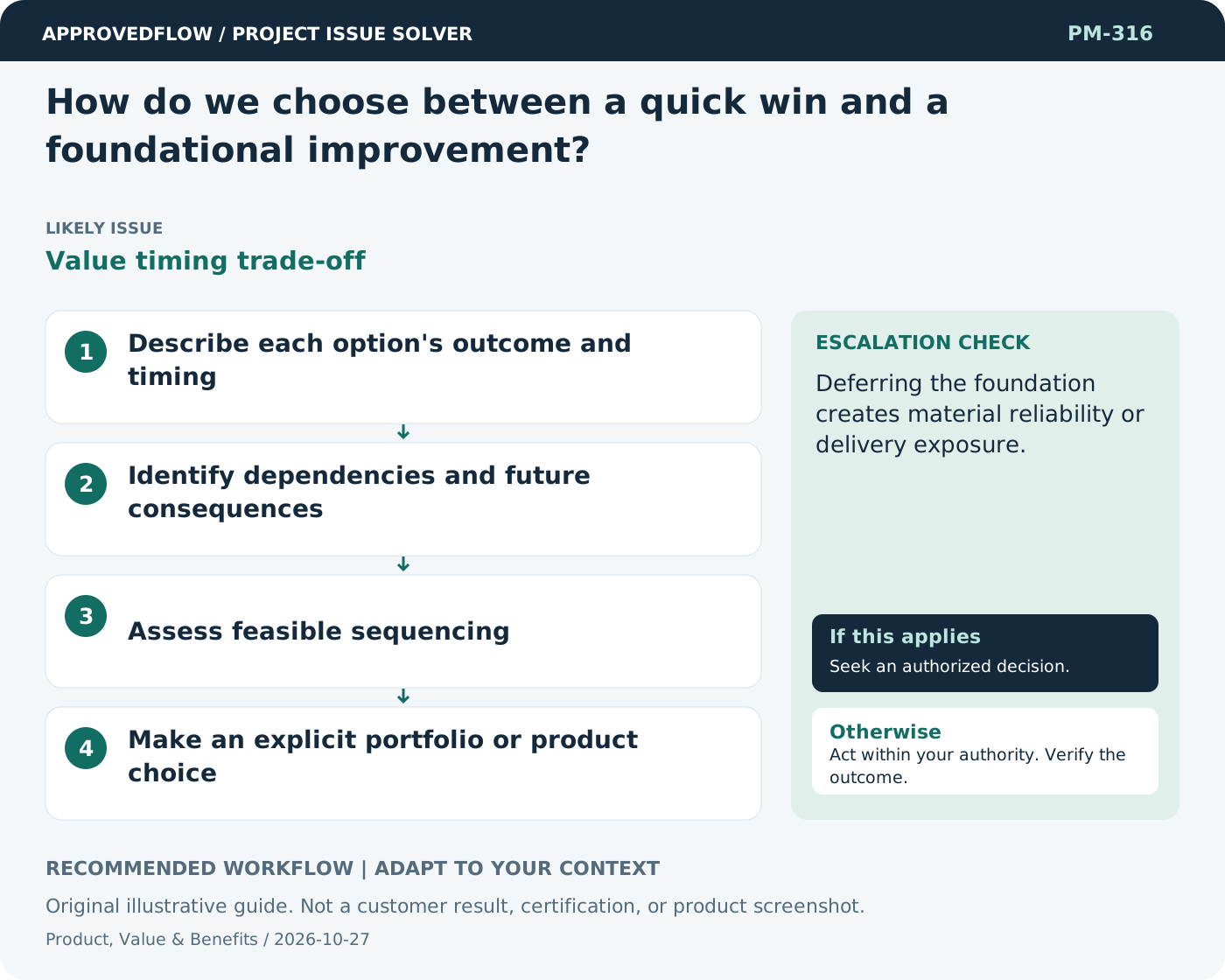
- Describe each option's outcome and timing
- Identify dependencies and future consequences
- Assess feasible sequencing
- Make an explicit portfolio or product choice
When to escalate
Escalate when
Deferring the foundation creates material reliability or delivery exposure.
Who decides
The product or business benefit owner
Example
A team pairs a small user improvement with essential data-quality work needed for future releases.
Mistake to avoid
Assuming only immediately visible features create value.
Prevent a repeat
Compare observed outcomes with the baseline and separate forecast benefits from benefits actually measured.
Suggested ApprovedFlow setup
- Projects
- Tasks
- Documents
Keep the intended outcome and measurement plan with the project, and assign improvement work to an accountable business owner. See the platform
Related cases
- Can customer feedback replace business metrics?Incomplete value evidence
- Should a project continue when the remaining cost exceeds the remaining value?Continuation decision
- Our utilization is high, but delivery is slow. Why?Utilization-flow trade-off
- How do we assess a new urgent project without derailing everything?Urgent intake trade-off